Answer first
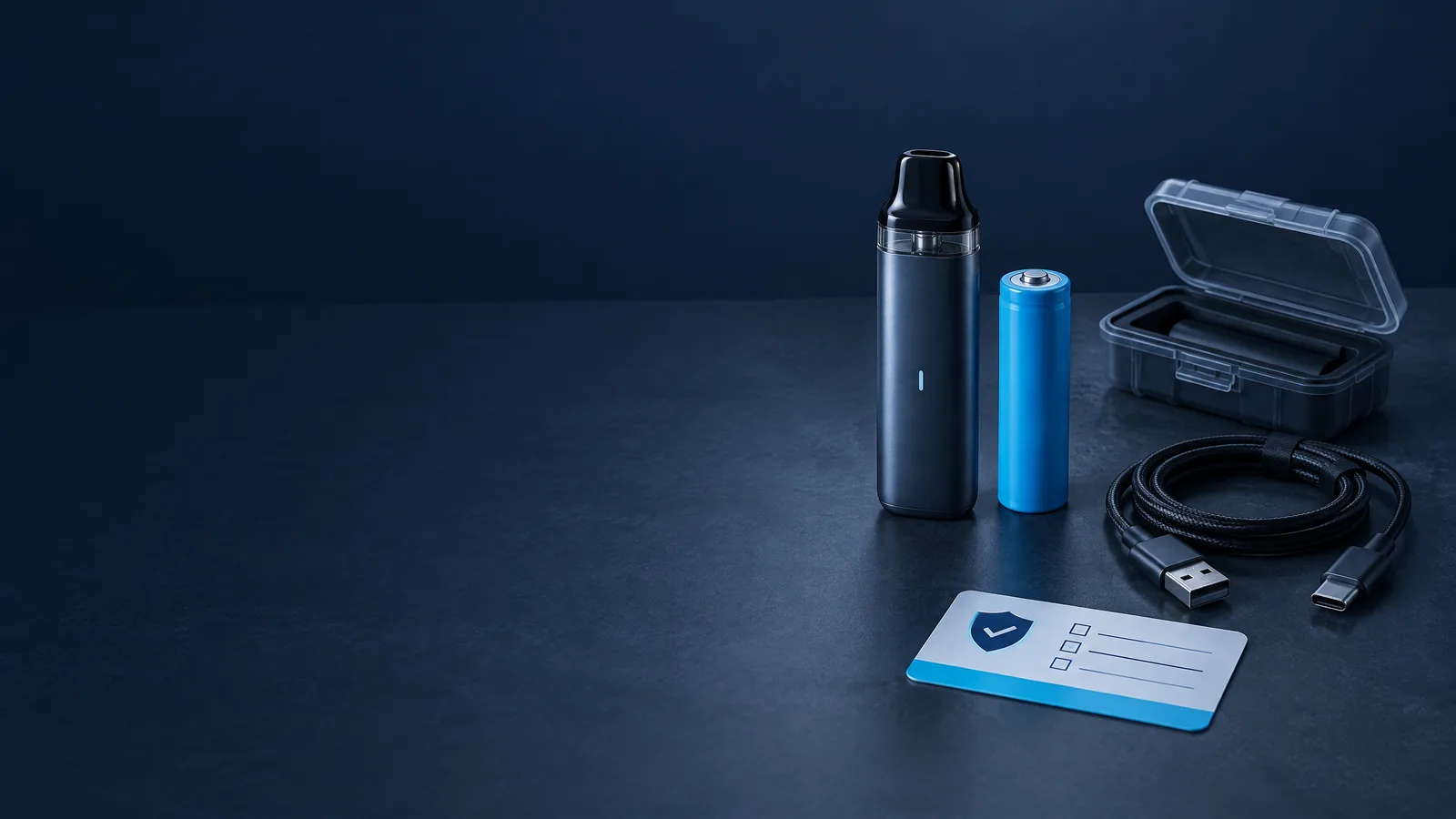
Rechargeable vaping devices use lithium-ion batteries, which Health Canada identifies as common in vaping products and capable of overheating, fire and explosion in certain conditions. The practical rule is simple: use a compatible, certified charger as directed; charge in view on a firm, non-soft surface; stop using damaged batteries; keep batteries dry, at room temperature and away from metal objects; and use the correct municipal drop-off route rather than household garbage.12
KEY TAKEAWAYS
- Do not use a swollen, dented, torn, worn or otherwise damaged lithium-ion battery.1
- Charge at room temperature, where the device can be seen, away from soft furnishings that can trap heat and away from exit doors.1
- Use the supplied charger or a compatible replacement from a trusted source; Health Canada identifies recognised Canadian certification marks including CSA, cUL and cETL.1
- Do not put batteries in household garbage. Follow local municipal hazardous-waste instructions and cover terminals with non-conductive tape at drop-off.2
General safety information only. This article does not replace the exact device manual, manufacturer guidance, airline instructions, municipal disposal rules or qualified professional advice.
Why vape battery safety needs a separate checklist
Lithium-ion batteries are rechargeable, high-energy batteries found in many consumer products, including vaping devices. Health Canada says they are generally safe when used properly, but can become hazardous when damaged or used in unsuitable conditions.1 That makes everyday decisions—where a device charges, how a spare battery is carried, whether visible damage is ignored, or how a depleted device is discarded—safety decisions rather than housekeeping details.
Product designs differ. An integrated-battery device, a removable cell, a device with a damaged charge port and a battery-powered accessory may not have the same operating instructions. Use this article as a Canadian safety reference and follow the instructions for the exact product.
Before charging: use a five-point safety check
The safest charging session begins before a cable is connected. Health Canada advises people not to throw, modify or tamper with lithium-ion batteries, and not to use batteries that are swollen, dented, have torn plastic wrappers or show other signs of damage or wear.1
| Check | What to confirm | Why it matters |
|---|---|---|
| Battery condition | No swelling, dents, torn wrapping, leakage, unusual heat or visible damage | Health Canada advises not using damaged or worn lithium-ion batteries.1 |
| Device condition | Charging port, cable and housing appear undamaged; product instructions are available | Do not modify or repair battery-powered devices unless the manufacturer recommends it.2 |
| Charger match | Use the supplied charger, or a compatible replacement from a trusted source | Health Canada advises checking voltage and current compatibility for replacements.1 |
| Charge location | Firm, open, room-temperature location that remains in view | Soft surfaces can trap heat; Health Canada also advises charging away from exit doors.1 |
| Time | Charge only for the recommended time | Charging longer than recommended can contribute to overheating.1 |
How to charge a vape battery more safely
Choose the right charger, not merely a connector that fits
A cable or plug that physically connects does not establish electrical compatibility. Use the charger supplied with the device whenever possible. If a replacement is necessary, Health Canada says to buy from a trusted source and confirm that voltage and current are compatible with the device.1 Its Canadian certification-mark guidance identifies marks such as CSA, cUL and cETL, and warns that chargers without recognised Canadian certification marks do not meet electrical safety standards.1
Choose an open, stable charging location
A good charging location is visible, dry and free of heat-trapping materials. Avoid charging on a bed, sofa or other soft surface. Keep the device away from exit doors, so an incident does not compromise a route out of the room.1 Do not leave a charging device inside a hot or cold car or in direct sun.
Storage and carrying: prevent damage and terminal contact
For lithium-ion batteries, Health Canada recommends room-temperature, dry storage out of children’s sight and reach.1 Its broader battery guidance also says to keep batteries away from metal objects such as coins or keys, and out of pockets, purses and bags where both terminals may contact metal at the same time.2
At home or in a workplace
Keep spare batteries in their original packaging when available, or use a protective non-metal case. Keep them away from direct sunlight, extreme temperatures, moisture, household chemicals and flammable or explosive materials.12 Do not put pressure on batteries or stack heavy objects on battery boxes.
When carrying a removable battery
Do not carry loose cells in a pocket, purse or bag with keys, coins or other metal items. Health Canada specifically recommends a protective non-metal case for carried batteries.12
When to stop using a device or battery
Stop using a battery that is swollen, dented, has a torn plastic wrapper or shows other damage or wear.1 Health Canada also advises against modifying or tampering with lithium-ion batteries and against modifying or repairing battery-powered devices unless the manufacturer recommends it.12
| Observed issue | Safer immediate response |
|---|---|
| Swelling, denting, torn wrapper or visible damage | Do not use or charge it; follow manufacturer and local disposal guidance.1 |
| Device or charging equipment appears damaged | Do not continue charging; seek product-specific assistance from the manufacturer or retailer.2 |
| Recalled battery or device | Follow the recall instructions. Transport Canada says damaged, defective, recalled and recycled batteries are forbidden from air transport.3 |
| Battery injury or incident | Health Canada says injuries can be reported to the original manufacturer; consumer incidents can also be reported to Health Canada through its consumer incident form.2 |
Travel by air: check the airline after reviewing Transport Canada guidance
Airline rules can change and can be stricter than general guidance. Check your airline, airport-security requirements and destination rules before leaving for the airport. This safety article does not determine whether a device is permitted on a particular airline, journey or destination.
Disposal in Canada: keep batteries out of household garbage
- Do not place a battery or device in household garbage. Batteries can still pose fire and injury risks after use.2
- Check the local municipality’s instructions. The municipality can identify its hazardous-waste or battery-collection route.1
- Protect terminals as directed. Health Canada says to cover battery terminals with non-conductive tape before drop-off.2
- Do not burn batteries. Health Canada says they may burst or explode.2
For an integrated device, do not dismantle it merely to separate the battery unless manufacturer instructions and the local program specifically support that method. Ask the manufacturer, retailer or municipal program how to handle the exact product.
What B2B teams should document before a device is supplied or shipped
Consumer safety information and B2B release controls have a shared objective: making the correct device, charger and handling instructions traceable. A trade release file should preserve manufacturer instructions, device and charger identifiers, battery specification, compatible accessories, Canadian certification information where applicable, packaging version, service contact and any applicable recall process.
Transport Canada explains that lithium batteries and devices containing them are dangerous goods for transportation. Shippers and importers must declare batteries to carriers and meet Transportation of Dangerous Goods Regulations requirements, including requirements around classification, documentation, labelling, packaging and training that vary by mode of transport.3
This does not mean a reader should create shipping documents without qualified support. It means trade buyers should obtain the responsible party’s documents before moving a lithium-battery-powered product through a commercial supply chain. Review Solvane’s shipping and logistics overview and quality and documentation pathway for related trade context.
Frequently asked questions
Can I charge a vaping device on a bed or sofa?
No. Health Canada says to charge lithium-ion batteries away from soft surfaces such as couches or beds because they can trap heat around the battery and cause a device to overheat. Charge at room temperature where the device can be seen and follow manufacturer instructions.1
Can I use any USB charger that fits my vape device?
No. Health Canada advises using the supplied charger or, for a replacement, confirming voltage and current compatibility. Buy replacements from a trusted source and look for recognised Canadian certification marks where applicable.1
What should I do with a swollen or damaged vape battery?
Do not use or charge it. Health Canada says not to use lithium-ion batteries that are swollen, dented, have torn plastic wrappers or show other damage or wear. Follow manufacturer and local disposal instructions for the specific item.1
Can I take a vape battery on a plane in Canada?
Transport Canada says lithium-battery-powered devices, including e-cigarettes, should be in carry-on baggage rather than checked luggage. Do not take damaged or recalled batteries, do not charge on board unless allowed by the airline, and check airline-specific rules before travel.4
Can I put a used vape or lithium-ion battery in the garbage?
No. Health Canada says batteries are hazardous waste and should not be put in household garbage. Follow municipal instructions and cover terminals with non-conductive tape before taking batteries to a drop-off centre.2
Official sources
- Health Canada — Battery safety: Lithium-ion batteries, page date 24 December 2025; reviewed 28 September 2026.
- Health Canada — Battery safety, page date 26 November 2024; reviewed 28 September 2026.
- Transport Canada — Shipping and importing lithium batteries and lithium battery-powered devices, page date 18 February 2026; reviewed 28 September 2026.
- Transport Canada — Lithium Batteries Part 2: What You Didn’t Know About Travelling with Them, page date 2 July 2025; reviewed 28 September 2026.